Patent pending · IEEE Access under review

Bring people safely back — the way they came.

Awdah AI builds map-free augmented-reality navigation that records a route as it's walked and guides a disoriented person back along it — no pre-built maps, no installed infrastructure, working entirely on-device and offline.

78%
lower trajectory error in heavy multipath
~16 cm
mean on-device return accuracy
0
maps, beacons, or internet required
Confidence0.94
Originlocked

Architecture

A self-trained engine — no design, no pre-built map.

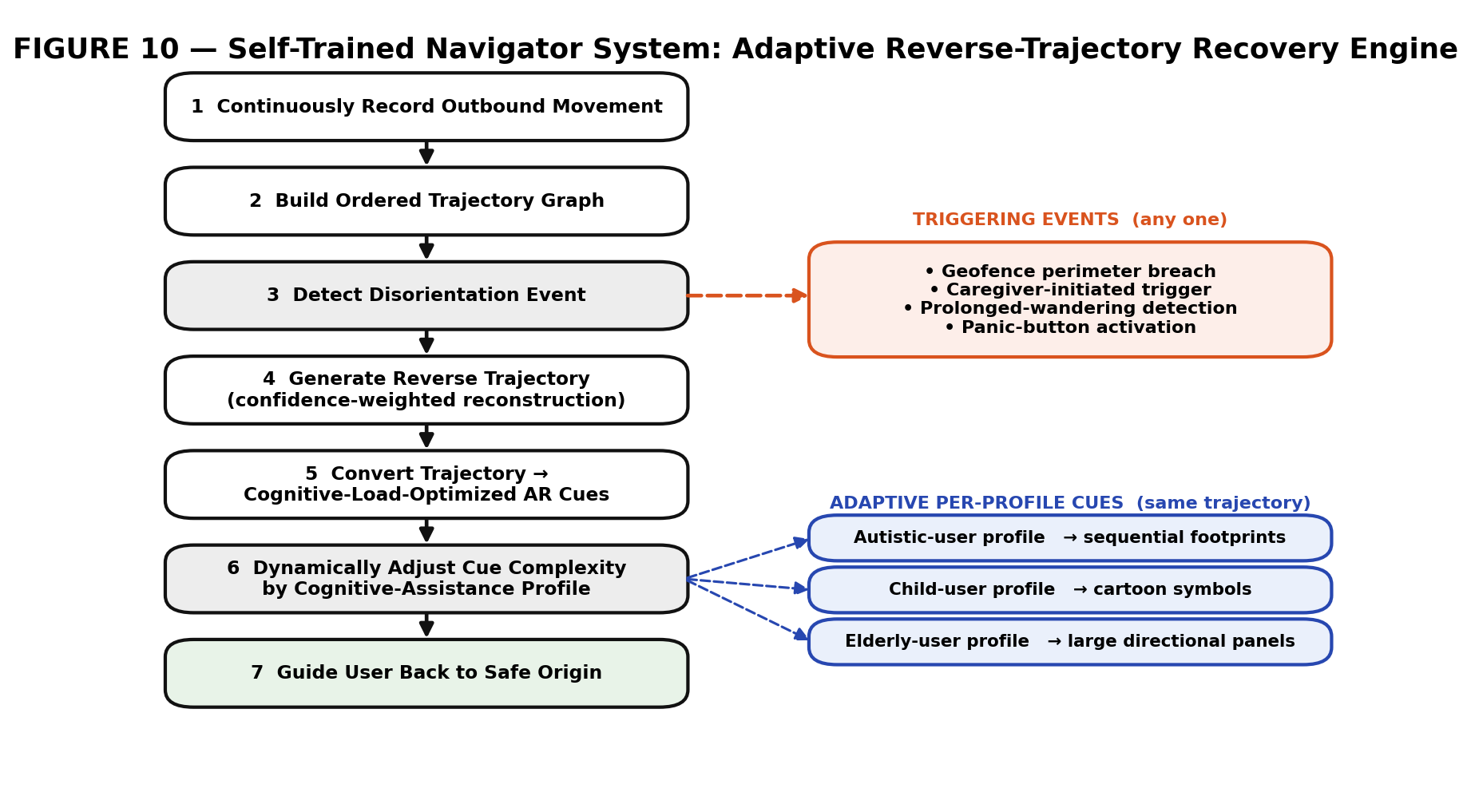
The route is authored simply by walking it once. Everything after that — reconstruction, detection, and guidance — happens automatically on-device.

  1. 01

    Learn

    Walk the route once. The app records position fixes on the phone as you go — outdoors via GPS, indoors via visual-inertial tracking.

  2. 02

    Reconstruct

    Confidence-Weighted Trajectory Reconstruction scores every fix and fuses them through a robust Kalman smoother, gating multipath outliers.

  3. 03

    Detect

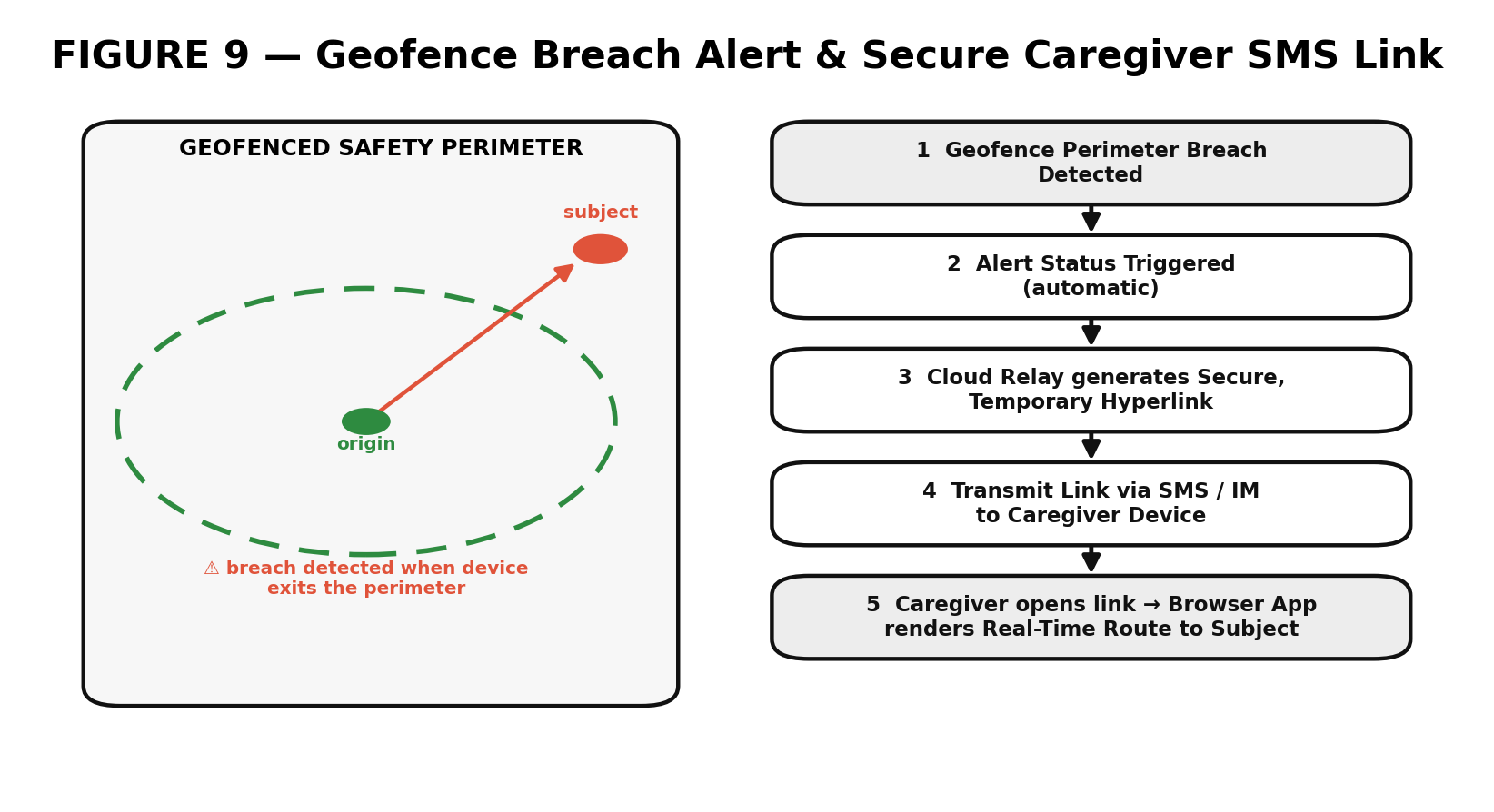
    A confidence-gated disorientation detector senses separation, wandering, a geofence breach, or a caregiver / panic trigger.

  4. 04

    Guide back

    The reconstructed route is reversed and rendered as profile-adaptive AR cues — footprints, arrows, or panels — leading the user home.

Core Algorithm · Patent §5.15

Confidence-Weighted Trajectory Reconstruction.

In heavy urban multipath, raw satellite fixes scatter wildly. Awdah weights each fix by accuracy, kinematics, and temporal gap, then filters through an RTS Kalman smoother with hard outlier gating.

SAFE ORIGIN DISORIENTATION EVENT
Confidence-Weighted RTS Trajectory Raw GPS Multipath Jitter (HDOP > 3.0) Gated Multipath Outlier (R_t inflated)
Confidence Scoring ct = c(acc) · c(kin) · c(tmp)

Multiplicative product gating horizontal dilution, pedestrian speed ceiling, and logging time intervals.

Kalman Variance Adapt Rt = σ02 / ct

Measurement-noise variance dynamically inflates on degraded fixes to eliminate visual cue jitter.

Benchmarked Reduction 78.4%

Trajectory error reduction achieved across 55-trace field trial around the Prophet's Mosque.

Accessibility Adaptation · Patent Fig. 11

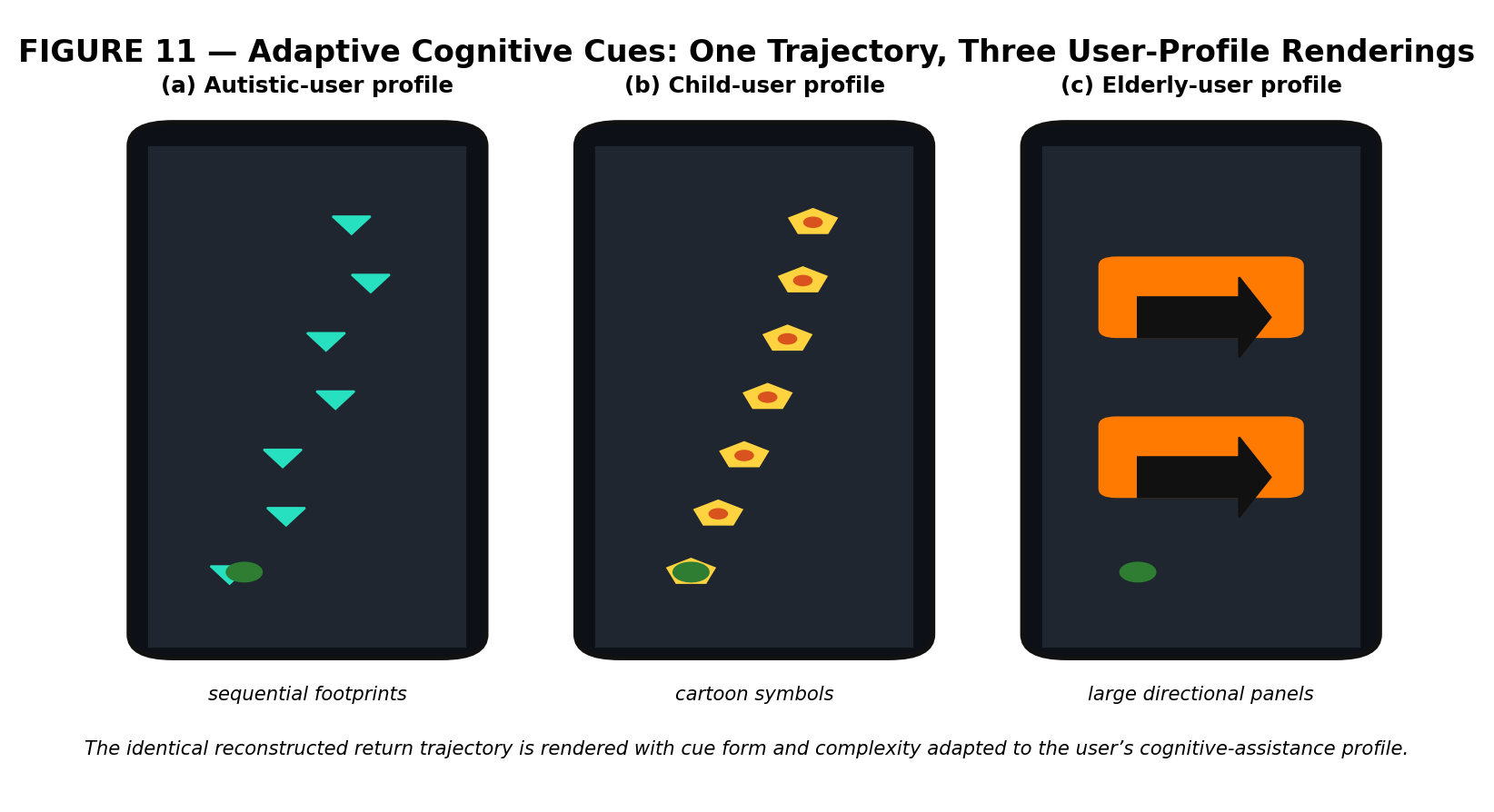
Identical trajectory, tailored cognitive load.

The engine reverses the same spatial path, but adapts the AR presentation layer to the subject's cognitive profile to avoid sensory overload or panic.

PROFILE: AUTISM ASSIST SAFE ORIGIN · 48 M
Floor-anchored step sequence reduces visual clutter and cognitive strain.
Cognitive Calibration

Autism Spectrum & Sensory Overload Mitigation

Traditional maps demand spatial rotation and multi-step cognitive abstraction. For users on the autism spectrum or experiencing sensory overwhelm, Awdah replaces cartography with floor-registered, non-blinking step cues that direct gaze downward to physical footsteps, calming sensory input.

  • Visual Modality: High-contrast floor-registered footstep sequence
  • Sensory Impact: Zero flashing or abrupt directional recalibrations
  • Cognitive Task: Direct physical mimicry — simply place feet on cues

Awdah AI in 60 seconds

See what map-free return navigation looks like.

A short introduction to Awdah AI — the problem, the idea, and what it feels like to be guided back to where you started.

Live On-Device Run

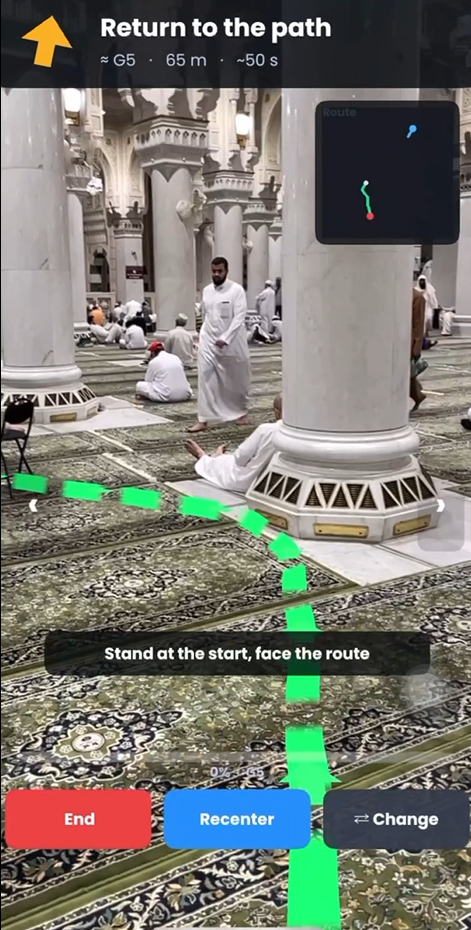
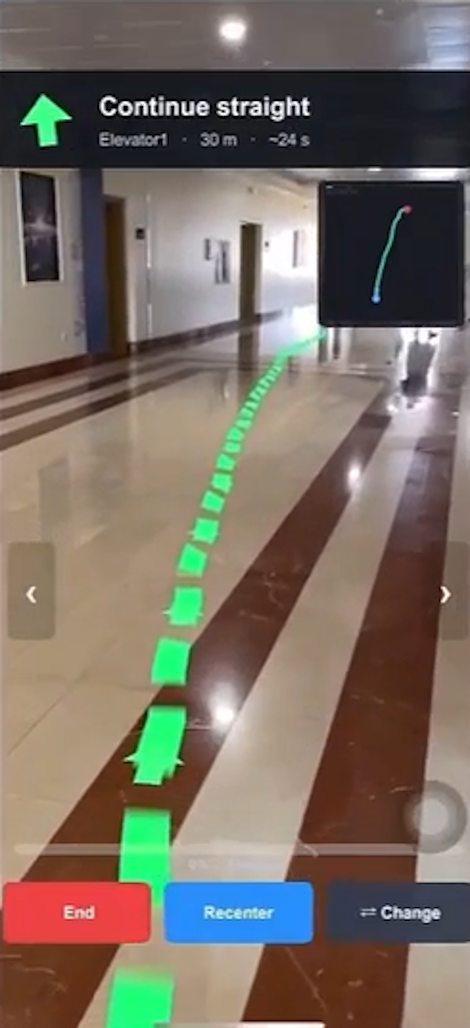
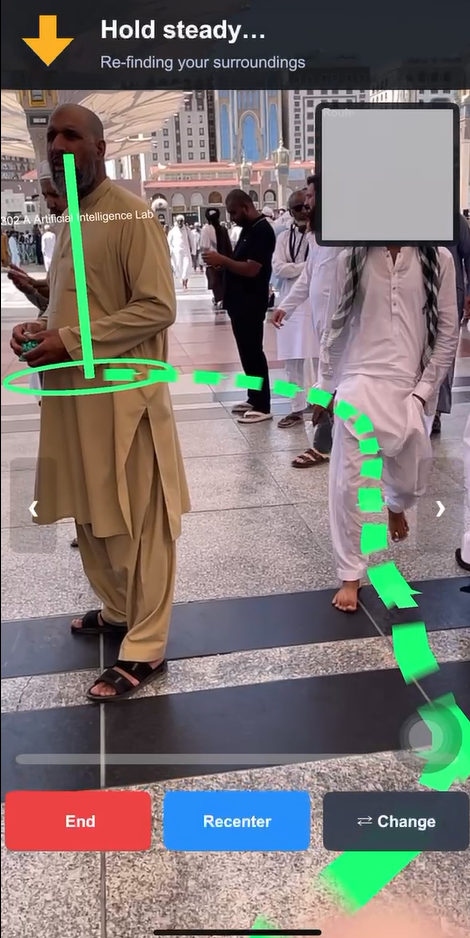
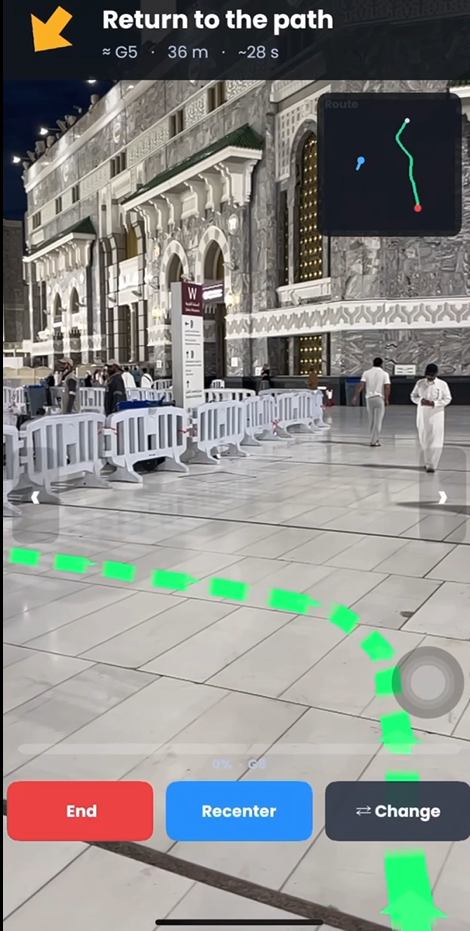
Watch Awdah guide a user back — live, on-device, offline.

A real recording of the deployed iOS prototype: a route is trained by walking it once, then re-navigated using floor-registered AR cues with no satellite signal and no pre-built map.

Recorded on iPhone 12 Pro · ARKit visual-inertial tracking Mean end-point accuracy: 15.8 cm across 21 on-device runs

Android app

Try Awdah on your own phone.

Download the Android build and walk a route once — then let Awdah guide you back along it, entirely on-device and offline.

  • ✓ Android 8.0 and above — no account or sign-up required.
  • ✓ Fully offline: your recorded routes stay on your phone.
  • ✓ Direct APK download — install straight from this page.
Download for AndroidAPK · 30 MB After downloading, open the file and allow “Install unknown apps” if Android asks.

Scan to download

Point your Android camera at the code to download app.apk directly.

app.apk

Where it matters

Built for the moment someone is lost.

From the dense crowds of the Haram district to hospitals, campuses, and family safety — the same map-free engine adapts to the venue and the user.

Hajj & Umrah — our first market

Reuniting pilgrims separated in the crowds of Makkah and Madinah, where satellite reception is heavily degraded by multipath and signage is limited. Validated with a 55-trace field campaign around the Prophet's Mosque.

Campuses & airports

Map-free wayfinding and return navigation in large, complex venues with zero installed infrastructure.

Hospitals

Helping patients and visitors retrace their way through unfamiliar buildings without relying on signage.

Autism & dementia safety

Designed for neurodiverse users and at-risk wanderers, with cueing calibrated to lower cognitive and sensory load.

Child safety

A parent follows AR arrows straight to a separated child in a crowd-dense venue — no app install required to find them.

Pet & animal recovery

The same two-device tracker/finder mode applies to recovering a wandering pet via its logged GPS path.

Intellectual Property · USPTO 64/084,040

Patent figures & system architecture.

Official drawings submitted under U.S. 35 U.S.C. § 111(b) for the Adaptive Reverse-Trajectory Recovery System and Method.

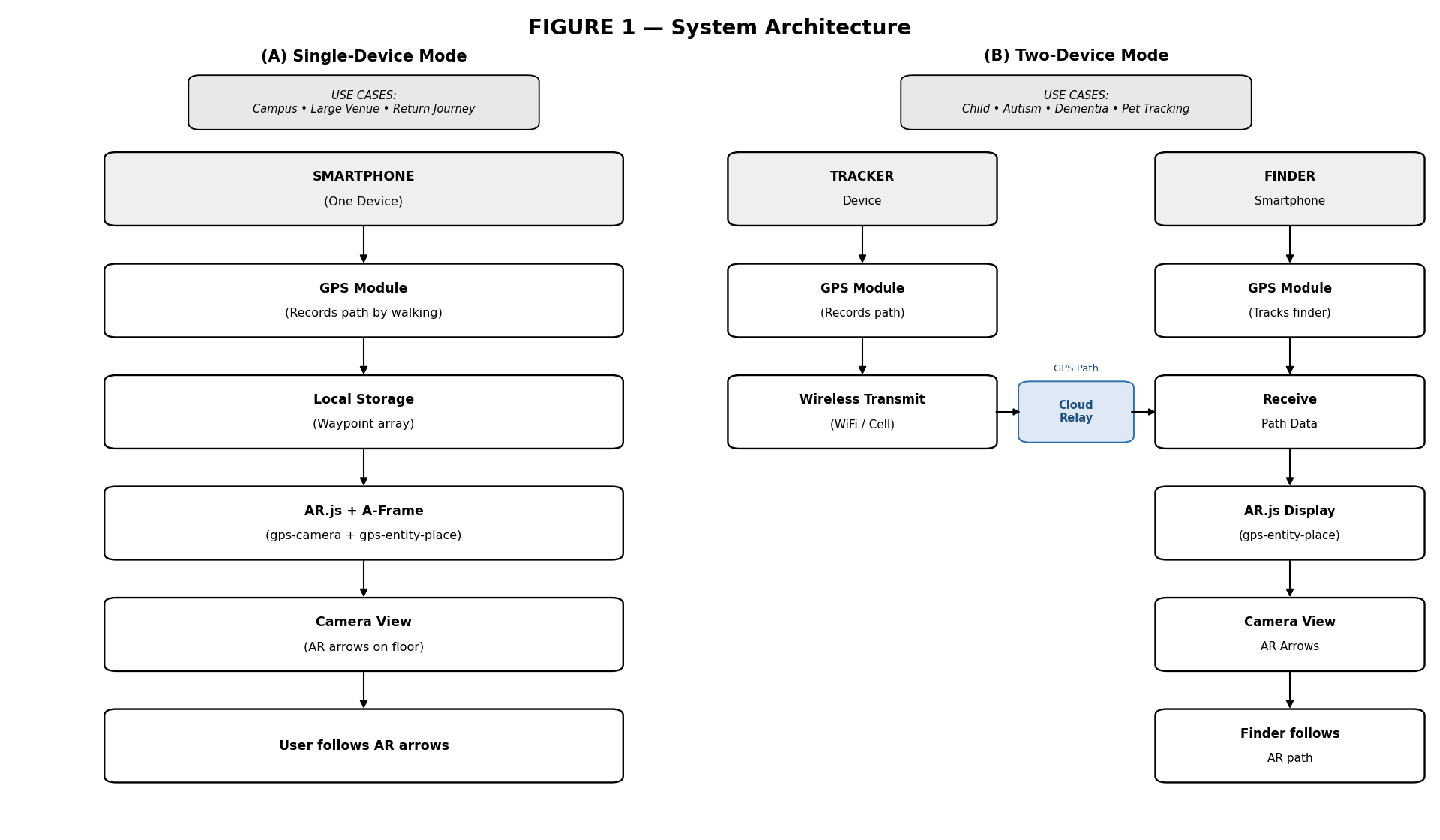
Patent Figure 1 System Architecture showing Single-Device and Two-Device relay modes
FIGURE 1

System Architecture: Single vs. Two-Device Tracking Modes

Depicts Single-Device mode for personal self-navigation and Two-Device mode with cloud relay for caregiver tracking.

Patent Figure 10 Adaptive Reverse Trajectory Recovery Engine flowchart
FIGURE 10

Adaptive Reverse-Trajectory Recovery Engine

Continuous outbound trajectory logging, disorientation state sensing, trajectory inversion, and profile-adaptive cue generation.

Patent Figure 11 Adaptive Cognitive Cues by User Profile
FIGURE 11

Cognitive Cue Profiles for Vulnerable Users

Comparison of footprint sequences (autism), cartoon icons (children), and oversized directional panels (elderly dementia).

Patent Figure 9 Geofence breach alert and secure caregiver SMS link
FIGURE 9

Geofence Breach & Instant Web-AR Caregiver Link

Automatic SMS dispatch with zero-install browser tracking URL upon departure from designated safety perimeter.

Founder & inventor

Built by a research engineer, not a slide deck.

MBH Founder & Inventor
Mohammad Belayet Hossain
Senior Member, IEEE · Founder & Inventor

Research and development engineer turned researcher with 18+ years of combined industry and academic experience. Currently a Research Assistant at the Dr. Hussein El-Sayyed Center for Scientific Research, University of Prince Mugrin, Al Madinah — leading work on safety-critical vehicle control, AI-based smart-city transportation, and adaptive XR systems.

Previously a Software Engineer at Advantest Corporation (Japan, 2006–2018), and later founded and led Inventus Limited (2018–2024). Sole inventor on two U.S. patent applications, including the adaptive reverse-trajectory recovery system behind Awdah AI.

B.Sc. CSE — BUET M.Sc. — Kyushu Sangyo University MEXT Scholar IEEE ITS Society IBCCES Autism Certified
2U.S. patent applications
7journal manuscripts in review
18+years combined experience

Ready to bring people home?

Whether it's pilgrims in Madinah, visitors in a crowd-dense venue, or a family member who wandered off — we'd like to talk about your use case.

Get in touch